DharmaPath
Festival calendar
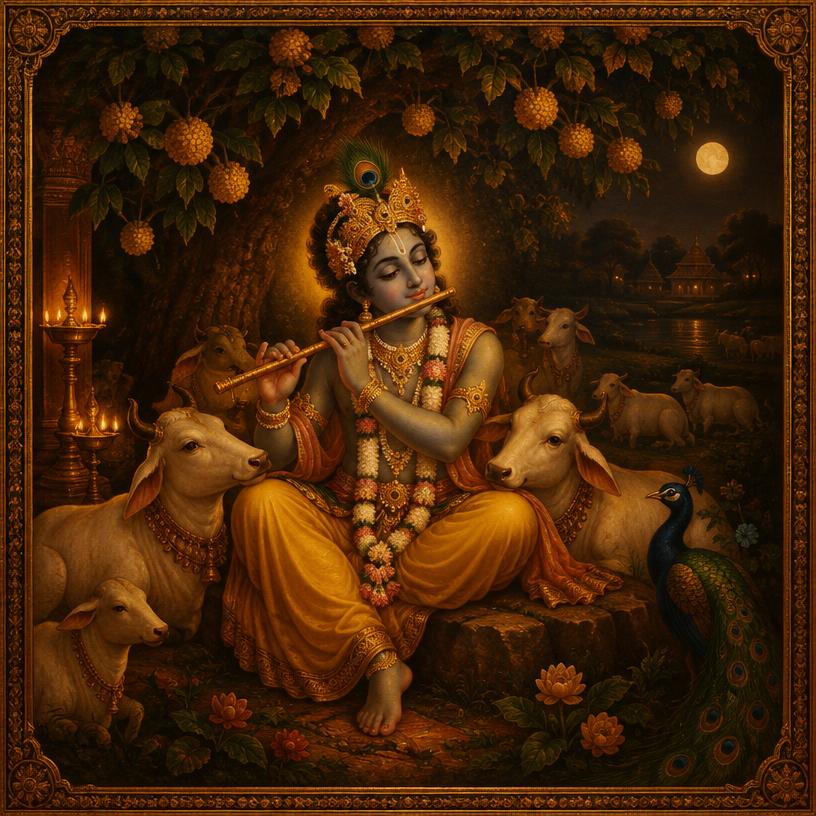
Gita Jayanti & Mokshada Ekadashi devotional artwork

गीता जयन्ती

Gita Jayanti & Mokshada Ekadashi

The day the Bhagavad Gita is taken to have been spoken — kept by reading it through, not by ceremony.

Date (2026)

20 December 2026

Tithi

Shukla Ekadashi

Month

Margashirsha

Deity

Krishna

Katha — the story behind it

01

The sacred story

At Kurukshetra, just before battle begins, Arjuna asks Krishna, his charioteer, to place their chariot between the two armies. Looking across the field, he recognises relatives, teachers, and friends. The thought of killing them overwhelms him. He lowers his bow and questions whether victory could justify such grief. Rather than dismissing his anguish, Krishna answers his questions about the self, duty, action, knowledge, and devotion. Their conversation forms the Bhagavad Gita, traditionally counted as seven hundred verses within the Mahabharata. Krishna teaches Arjuna to act with discernment, without clinging to the rewards of action, and with devotion. As the dialogue unfolds, Arjuna’s confusion gives way to clarity, and he becomes ready to fulfil his responsibility. Gita Jayanti commemorates this teaching and is traditionally observed on Mokshada Ekadashi. Families and temples may read or recite the Gita, discuss its meaning, offer पूजा to Krishna, and observe an Ekadashi व्रत. Different philosophical traditions understand the teaching in distinct ways, emphasising devotion, knowledge, or disciplined action. These readings need not be flattened into one account: the festival invites sincere reflection on how spiritual understanding can guide difficult choices.

02

Meaning within the story

The day the Bhagavad Gita is taken to have been spoken — kept by reading it through, not by ceremony. This is the one major observance whose object is an argument rather than an event or a person. It fits the season — the coldest, quietest part of the year, when long reading is possible — and it is the clearest instance in the calendar of understanding being treated as worship.

03

How the story becomes worship

Ekadashi vrat: The text is about acting without grasping at the result. The fast puts the body in a small version of that discipline while it is read. Gita Path: The Gita is a conversation with a shape. Reading it whole keeps the argument intact rather than harvesting verses from it. Puja of the text: The text is treated as the deity's speech, so it receives what the image would. The honour is placed on words, not an idol. Reflection and paran: The Gita was spoken in dialogue. Keeping it as dialogue rather than recitation matches its own method.

Where it comes from

Bhagavad Gita (Mahabharata, Bhishma Parva)Padma PuranaBrahmanda PuranaGita Mahatmya

Puja samagri — what to gather

  • ·A copy of the Bhagavad Gita
  • ·Tulsi leaves and yellow flowers
  • ·A ghee lamp
  • ·Fruit and milk for the Ekadashi fast

Vrat — the fast

Full Ekadashi vrat: no grain, beans or rice; fruit, milk and water for those who cannot keep it strictly.

Aarti & shloka — read, understand, listen

Aarti · common version

Aarti Kunj Bihari Ki

आरती कुंजबिहारी की, श्री गिरिधर कृष्ण मुरारी की॥ गले में बैजन्ती माला, बजावै मुरली मधुर बाला। श्रवण में कुण्डल झलकाला, नन्द के आनन्द नन्दलाला॥ गगन सम अंग कान्ति काली, राधिका चमक रही आली। लतन में ठाढ़े बनमाली, भ्रमर सी अलक कस्तूरी तिलक॥ आरती कुंजबिहारी की॥

Roman transliteration

Aarti Kunj Bihari ki, Shri Giridhara Krishna Murari ki. Gale mein Vaijayanti mala, bajavai murali madhura bala.

Complete aarti meaning

This is the aarti of Krishna, the grove-dwelling lifter of Govardhana and vanquisher of Mura. Wearing the Vaijayanti garland, he plays the sweet flute; earrings shine at his ears and he is Nanda's delight. Dark as a rain cloud, crowned with forest flowers and a musk tilak, he stands radiant beside Radha.

Sung with temple-style devotional accompaniment

Shloka · with meaning

Krishna pranam

वसुदेवसुतं देवं कंसचाणूरमर्दनम्। देवकीपरमानन्दं कृष्णं वन्दे जगद्गुरुम्॥

Vasudeva-sutaṁ devaṁ, Kaṁsa-Cāṇūra-mardanam; Devakī-paramānandaṁ, Kṛṣṇaṁ vande Jagadgurum.

Meaning

I bow to Krishna, son of Vasudeva, joy of Devaki, vanquisher of tyranny, and teacher of the world.

A Braj aarti widely sung for Krishna; temple verses and pronunciation vary by region.

Next in the year

Makar Sankranti

14 January 2026

Continue

From the day to the doing

Want to perform this puja properly, at home or at a temple?

Puja mode walks the full sequence — simple or detailed — with the meaning of every act.

Open puja mode