DharmaPath
Festival calendar
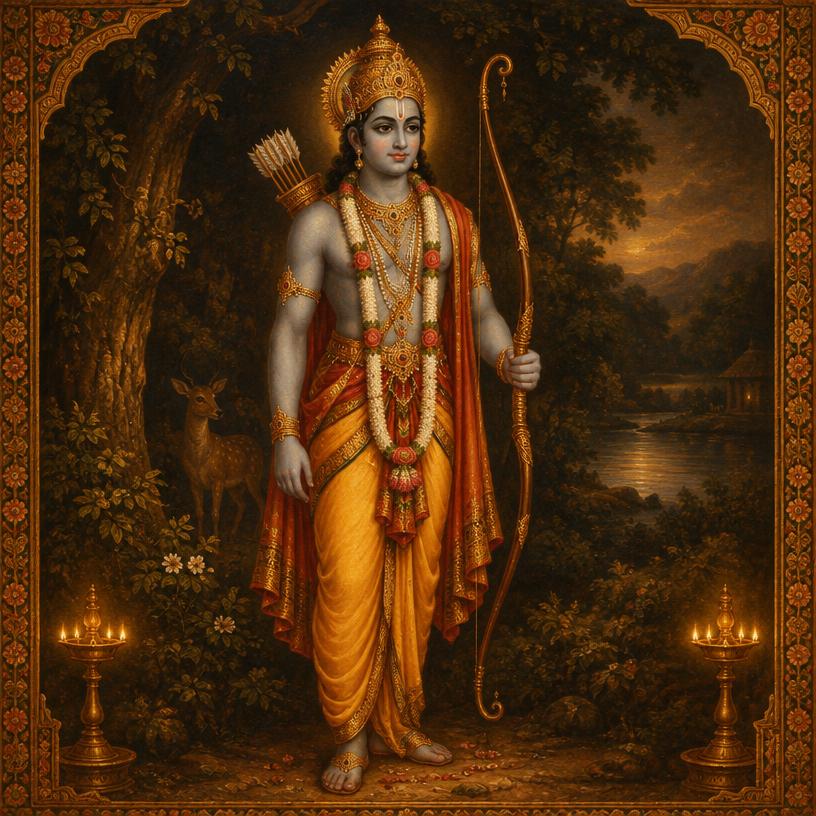
Rama Navami devotional artwork

राम नवमी

Rama Navami

The birth of Rama, kept at midday rather than midnight — with the Ramayana read aloud rather than merely worshipped.

Date (2026)

26 March 2026

Tithi

Shukla Navami

Month

Chaitra

Deity

Rama

Katha — the story behind it

01

The sacred story

Rama Navami celebrates Rama’s birth into the royal household of Ayodhya. King Dasharatha had no child to continue his family and carry its responsibilities. Seeking a blessing, he arranged the Putrakameshti yajna. In the traditional narrative, a divine being emerged from the sacrificial fire carrying a vessel of sacred payasam, which Dasharatha distributed among his queens. In time, Kausalya gave birth to Rama, Kaikeyi to Bharata, and Sumitra to the twins Lakshmana and Shatrughna. Their arrival brought joy to the palace and the city. Rama’s birth is traditionally celebrated at noon on Chaitra Shukla Navami; some tellings also emphasize the Punarvasu nakshatra. Devotees mark the occasion with व्रत, पूजा, readings or singing from Rama’s story, and a midday आरती. In some homes and temples, a small image of the infant Rama is placed in a cradle, and प्रसाद is shared. The birth story opens a life remembered for duty, compassion, and difficult moral choices. It encourages families to welcome children with love and to use power responsibly. Regional Ramayana traditions differ in details and emphasis, while honouring Rama’s arrival as a source of hope.

02

Meaning within the story

The birth of Rama, kept at midday rather than midnight — with the Ramayana read aloud rather than merely worshipped. Where Krishna's birth is kept at midnight in secrecy, Rama's is kept at noon in the open — the two festivals encode two different ideals, the hidden and the public. Rama Navami closes Chaitra Navaratri, so the nine days of restraint end in a birth rather than a battle.

03

How the story becomes worship

Path — the reading: Rama is honoured as conduct rather than power. Reading the account is a closer form of worship than offering to an image. Noon observance: The birth is placed at noon in the text — the light at its height, matching the character the epic describes. Panakam and kosambari: The festival falls as the heat starts. These three are cooling, rehydrating and cheap enough to hand out in quantity. Aarti and Ram Raksha: The stotra names the body part by part and asks protection for each — a deliberate, unhurried close to the day.

Where it comes from

Valmiki Ramayana, BalakandaRamcharitmanasAgastya SamhitaKalika Purana

Puja samagri — what to gather

  • ·An image or picture of Rama, or the Ram Darbar
  • ·Tulsi leaves, yellow flowers, chandan
  • ·Panakam (jaggery, pepper, cardamom water), neer mor, kosambari
  • ·A copy of the Ramcharitmanas or Valmiki Ramayana
  • ·Ghee lamp, incense, akshata

Vrat — the fast

Many fast on fruit and milk until noon, breaking after the birth observance. Some keep the full Chaitra Navaratri fast, ending today.

Aarti & shloka — read, understand, listen

Aarti · common version

Shri Ramachandra Kripalu

श्रीरामचन्द्र कृपालु भजु मन हरण भवभय दारुणम्। नवकंज लोचन कंज मुख कर कंज पद कंजारुणम्॥ कन्दर्प अगणित अमित छवि नवनील नीरद सुन्दरम्। पटपीत मानहुँ तड़ित रुचि शुचि नौमि जनक सुतावरम्॥ भजु दीनबन्धु दिनेश दानव दैत्य वंश निकन्दनम्। रघुनन्द आनन्द कन्द कोशल चन्द दशरथ नन्दनम्॥ सिर मुकुट कुण्डल तिलक चारु उदारु अंग विभूषणम्। आजानुभुज शर चाप धर संग्राम जित खरदूषणम्॥

Roman transliteration

Shri Ramachandra kripalu bhaju mana, harana bhava-bhaya darunam; nava-kanja lochana, kanja mukha, kara kanja pada kanjarunam.

Complete aarti meaning

O mind, adore compassionate Ramachandra, who removes the terrible fear of worldly existence. His eyes, face, hands and feet are compared to fresh lotuses; his beauty to a new rain cloud lit by yellow garments. He is friend of the humble, joy of Raghu's line, son of Dasharatha and victor over destructive forces.

Sung with temple-style devotional accompaniment

Shloka · with meaning

Rama nama verse

श्री राम राम रामेति रमे रामे मनोरमे। सहस्रनाम तत्तुल्यं रामनाम वरानने॥

Śrī Rāma Rāma Rāmeti, rame Rāme manorame; sahasranāma tat tulyaṁ, Rāma nāma varānane.

Meaning

Repeating the name Rama brings delight; tradition holds it equal in merit to the thousand names.

This is Tulsidas's celebrated stuti, commonly offered in the place of or alongside aarti.

Next in the year

Hanuman Jayanti

1 April 2026

Continue

From the day to the doing

Want to perform this puja properly, at home or at a temple?

Puja mode walks the full sequence — simple or detailed — with the meaning of every act.

Open puja mode