DharmaPath
Festival calendar
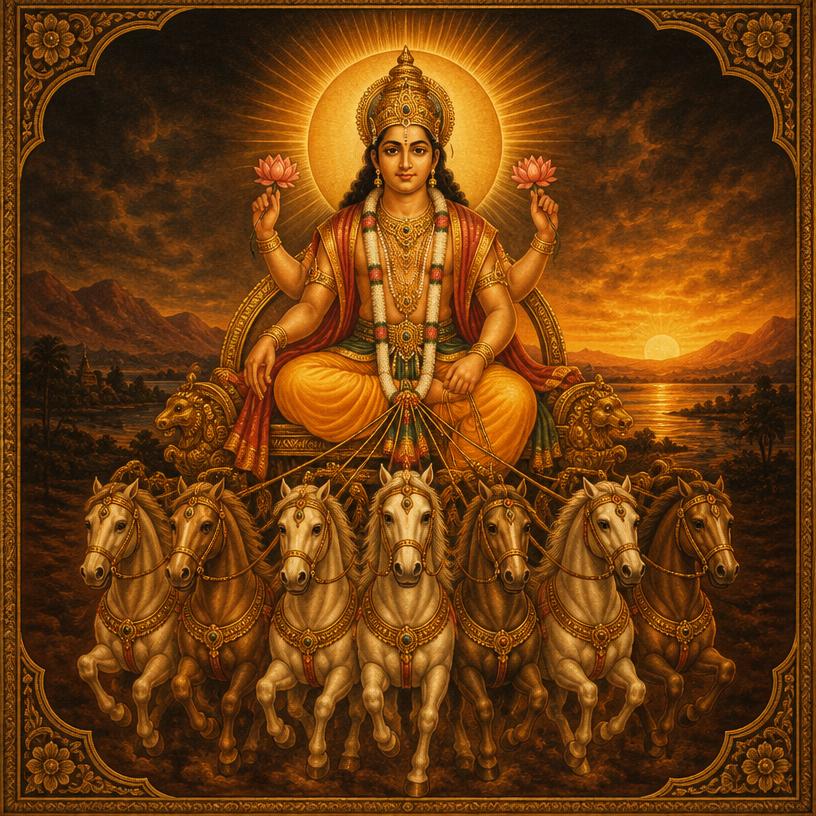
Chhath Puja devotional artwork

छठ पूजा

Chhath Puja

Four days of the hardest household fast in the tradition, and the only widely kept rite that offers to the setting sun before the rising one.

Date (2026)

13–16 November 2026

Tithi

Shukla Chaturthi to Saptami

Month

Kartika

Deity

Surya and Chhathi Maiya

Katha — the story behind it

01

The sacred story

Chhath brings together gratitude to Surya, the Sun, and devotion to Chhathi Maiya, who is associated in many traditions with Shashthi, a goddess protecting children. One familiar account remembers Karna, Surya’s son, standing in water and offering worship to his divine father. His steady devotion gives families an image of faith expressed through discipline rather than display. Other popular retellings connect the observance with Draupadi and the Pandavas during hardship; some also name Kunti. These accounts vary, and ancient hymns praising the Sun should not be treated as proof that every feature of today’s Chhath existed unchanged in Vedic times. The festival turns these memories into a demanding shared practice. Those keeping the व्रत prepare with bathing, simple food, and careful cleanliness, followed by fasting. Families gather beside water to offer arghya first to the setting Sun and then, the next morning, to the rising Sun. Fruit, thekua, and other offerings become प्रसाद. Honouring both sunset and sunrise teaches gratitude through life’s endings as well as beginnings. Regional stories differ, but care for children, restraint, devotion, and respect for the natural world remain central.

02

Meaning within the story

Four days of the hardest household fast in the tradition, and the only widely kept rite that offers to the setting sun before the rising one. Chhath has no priest, no image and no temple: the offering is made by the fasting person, standing in a river, to something visibly present. It is also ecologically exact — the prasad is entirely seasonal, the vessels are bamboo and clay, and the site is the shared riverbank.

03

How the story becomes worship

Nahay Khay: The fast is entered gradually. The body is prepared before anything is demanded of it. Kharna: A single measured meal marks the boundary. Everything after it is counted. Sandhya Arghya: Almost nothing else in the tradition worships decline. Offering first to the sun going down states that the giver is owed thanks in ebb as well as rise. Usha Arghya and paran: The vigil in cold water through the night between the two offerings is the whole vrat. It is undertaken without a priest — the fasting person performs it directly.

Where it comes from

Rigveda, Surya SuktasMahabharata, Vana ParvaBrahma PuranaSkanda Purana

Puja samagri — what to gather

  • ·Bamboo soop and daura baskets
  • ·Thekua, rice laddoo, seasonal fruit — sugarcane, banana, coconut, water chestnut
  • ·Whole turmeric, ginger and radish with leaves attached
  • ·Sindoor, a clay lamp, new unstitched cloth

Vrat — the fast

Thirty-six hours nirjala — without food or water — from Kharna's evening meal to the morning arghya. Physically the most demanding vrat in common practice.

Aarti & shloka — read, understand, listen

Aarti · common version

Om Jai Surya Bhagwan

ॐ जय सूर्य भगवान, जय हो दिनकर भगवान। जगत के नेत्र स्वरूपा, तुम हो त्रिगुण स्वरूपा। धरत सब ही तव ध्यान, ॐ जय सूर्य भगवान॥ सारथी अरुण हैं प्रभु तुम, श्वेत कमलधारी। तुम चार भुजाधारी, अश्व हैं सात तुम्हारे। कोटि किरण पसारे, ॐ जय सूर्य भगवान॥

Roman transliteration

Om jai Surya Bhagavan, jai ho Dinakar Bhagavan. Jagat ke netra svarupa, tum ho triguna svarupa. Dharata sab hi tava dhyana.

Complete aarti meaning

Glory to Lord Surya, maker of the day. You are the eyes of the universe and embody nature's three qualities; all beings meditate upon you. Aruna is your charioteer, you hold the white lotus, and your seven horses carry your countless rays across creation.

Sung with temple-style devotional accompaniment

Shloka · with meaning

Surya pranam

जपाकुसुमसंकाशं काश्यपेयं महद्युतिम्। तमोऽरिं सर्वपापघ्नं प्रणतोऽस्मि दिवाकरम्॥

Japākusuma-saṅkāśaṁ Kāśyapeyaṁ mahādyutim, tamo'riṁ sarva-pāpa-ghnaṁ praṇato'smi Divākaram.

Meaning

I bow to the sun, radiant like the hibiscus, descendant of Kashyapa, destroyer of darkness and wrongdoing.

A common North Indian Surya aarti and the traditional Surya pranam verse; wording can differ by prayer book.

Next in the year

Gita Jayanti & Mokshada Ekadashi

20 December 2026

Continue

From the day to the doing

Want to perform this puja properly, at home or at a temple?

Puja mode walks the full sequence — simple or detailed — with the meaning of every act.

Open puja mode